We use cookies to make your experience better. To comply with the new e-Privacy directive, we need to ask for your consent to set the cookies. Learn more.

Everything you need to know about MAF Vs Speed Density
April 22, 2022
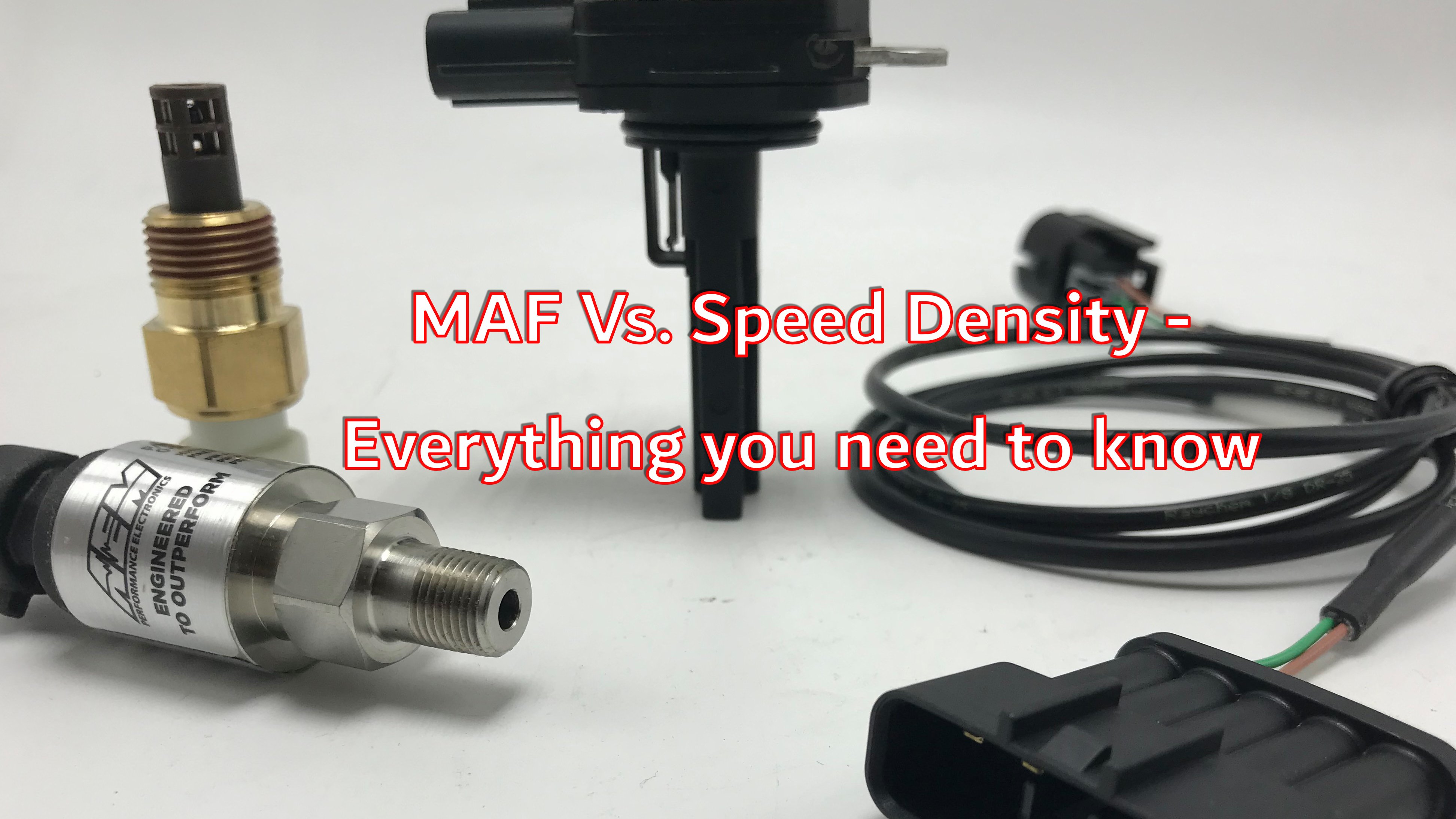
We had a number of questions come in for our Question of the Week about switching from MAF based tuning to Speed Density and I decided to reach out to Harvey from The Boostcreep who has been tuning our cars for well over a decade to get to have a detailed conversation about how these two systems work, and when and why you might want to make the switch to speed density tuning.
We didn't know how long this might go, but when it was all done, I decided to put up our whole conversation as a Podcast rather than to break it down into a much smaller video that would just be a Question of the Week.
Hopefully this will give you a much better understanding about what Mass Airflow tuning is, what Speed Density tuning is, and when you might want to consider making the switch.
Thanks for watching and Stay Tuned!
Here is a summary of the key points discussed in this episode:
The Goal of Both Systems [03:00]
Both MAF and Speed Density systems have the exact same goal: to determine the mass of the air entering the engine. By knowing the exact mass of the air, the ECU can calculate the precise mass of fuel required to maintain the desired air/fuel ratio (the chemistry of combustion).
How Mass Air Flow (MAF) Works [04:56]
Direct Measurement: MAF is considered a "shortcut" because it measures the mass of the air directly.
The Mechanism: It typically uses a "hot wire" element. As air flows past the heated wire, the air molecules cool it down. The sensor measures how much voltage is required to maintain the wire's temperature. Since the cooling effect is proportional to the number of molecules (mass) hitting the wire, the ECU instantly knows the mass of the incoming air.
The Pros: It calculates fueling in real-time. If the engine's volumetric efficiency changes (e.g., due to engine wear, a plugged exhaust, or altitude changes), the MAF sensor immediately adapts because it just reads whatever air is actually flowing in.
The Cons:
MAF sensors are highly sensitive and easily damaged/skewed by dirt or oil (especially from aftermarket oiled air filters).
They are easily thrown off by vacuum leaks. Because the sensor is located near the air filter, any air that escapes or enters the system after the sensor (via a leak) ruins the calculation.
In big-turbo or high-flow setups, large intake pipes can cause turbulence that prevents the small sensor element from getting an accurate reading of the total airflow in the pipe. Also, big turbos can cause air turbulence and "reversion" when letting off the throttle, which confuses the MAF and causes the engine to stall.
How Speed Density Works [05:20]
Indirect Measurement (Calculation): Speed Density does not directly measure air mass. Instead, it relies on a Manifold Absolute Pressure (MAP) sensor, an Intake Air Temperature (IAT) sensor, and engine RPM to calculate the air mass.
The Mechanism: It uses the Ideal Gas Law (PV=nRT). By measuring the absolute pressure and absolute temperature in the intake manifold, and knowing the engine's fixed volume (displacement), the ECU looks up a pre-calibrated Volumetric Efficiency (VE) table to deduce the mass of the air.
The Pros:
It is much more robust for race cars. Because it calculates based on pressure inside the manifold, a blown intercooler pipe or a vacuum leak won't immediately cause the car to stall or run dangerously lean like a MAF system would.
You can change intake pipes/filters freely without needing a retune, as the calculation is done downstream in the manifold.
Tuners report that Speed Density often provides a smoother idle and better drivability on highly modified (400+ HP) setups because it isn't subject to the intake turbulence that confuses a MAF sensor.
The Cons:
It is entirely reliant on the accuracy of the tuner's VE table.
If the engine's physical efficiency changes (e.g., a burnt exhaust valve, different camshafts, or cylinder wear), the ECU won't know. The lookup table will remain the same, causing the air/fuel mixture to be wrong until the car is retuned.
Changes in backpressure (like driving from sea level to 12,000 feet) change the engine's pumping efficiency. Without a Barometric pressure offset sensor and proper tuning compensation, a Speed Density car will run lean at high altitudes.
When to Switch to Speed Density [40:36]
High Horsepower/Big Turbos: Once a Subaru build exceeds roughly 400 horsepower, or uses a rotated/large turbo setup, the MAF sensor often becomes a liability due to intake turbulence and sizing constraints.
Race Cars: For dedicated track cars, the reliability of a MAP sensor over a fragile MAF sensor—and the ability to survive a minor boost leak mid-race without stalling—makes Speed Density highly desirable.
Smoother Drivability: For cars with aggressive aftermarket intakes or large turbos that suffer from jerky drivability or stalling when letting off the throttle, Speed Density calculations often result in a much smoother running engine.

Share on Facebook

Share on X

Share on Pinterest